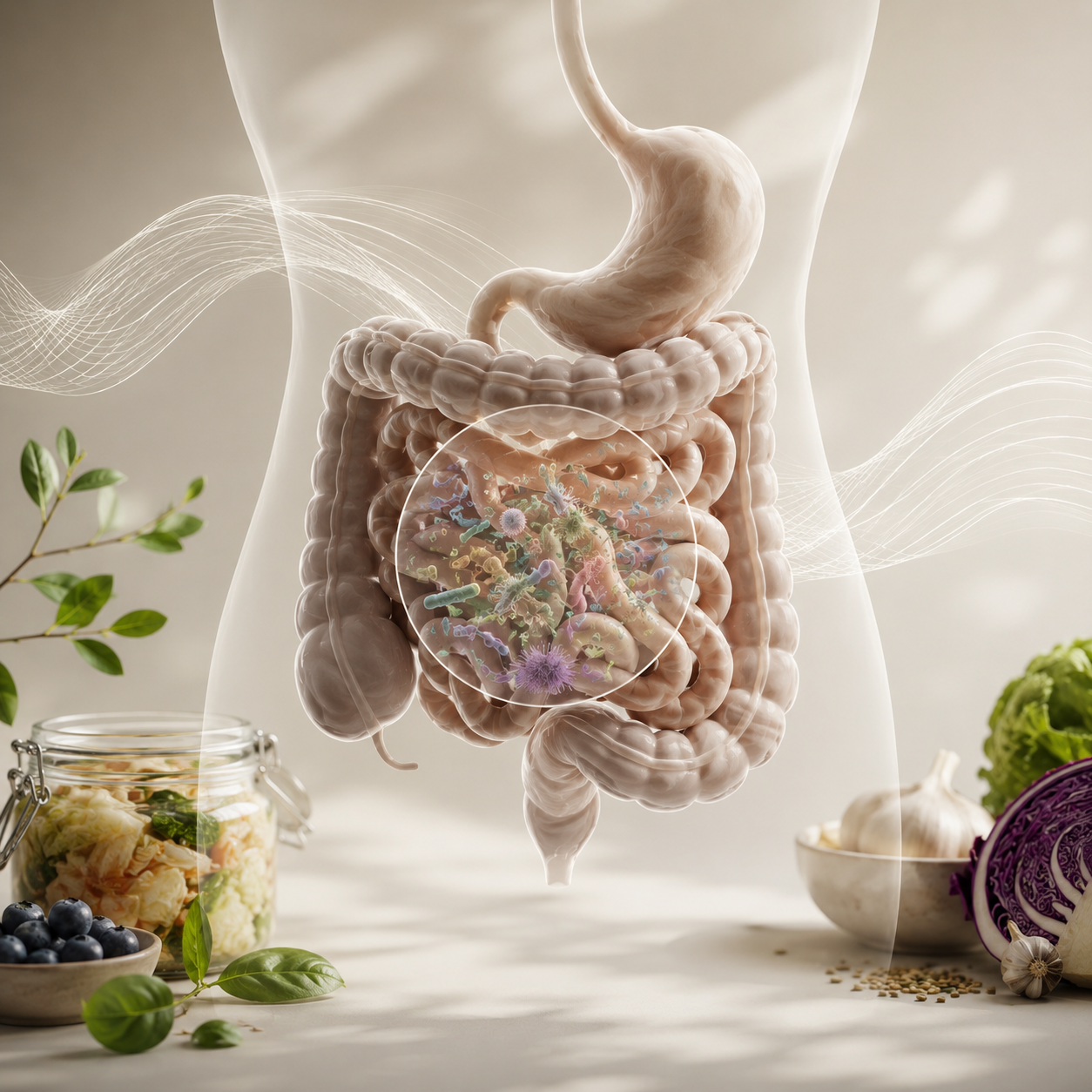
What current research actually shows about gut bacteria, intestinal permeability, fermentation, and fiber, and where gut health marketing gets ahead of the evidence.
By the Repeat Editorial Team Medically informed, evidence-based
| TL;DR THE 60-SECOND VERSION |
| • The gut microbiome is a community of trillions of bacteria whose diversity is consistently linked to better metabolic, immune, and even cognitive outcomes; lower diversity shows up repeatedly in chronic disease and aging research. |
| • “Leaky gut syndrome” is not a recognized medical diagnosis. The underlying phenomenon, increased intestinal permeability, is real and measurable, but it is a feature of specific conditions like inflammatory bowel disease, not a standalone catch-all explanation for unrelated symptoms. |
| • A landmark Stanford trial found that a 10-week diet high in fermented foods increased microbiome diversity and lowered 19 markers of inflammation; a matched high-fiber diet, surprisingly, did neither in the same short window. |
| • Fiber is the most underconsumed nutrient in the Western diet: roughly 95% of Americans fall short of daily recommendations. Fiber feeds the bacteria that produce short-chain fatty acids like butyrate, the gut’s primary anti-inflammatory fuel source. |
| • Chronic low-grade inflammation driven by gut bacteria, often through a process called LPS translocation, is now considered a contributing mechanism in conditions ranging from cardiovascular disease to autoimmune disorders. |
| • Fermentation is not a wellness trend. It is one of humanity’s oldest food technologies, independently developed across civilizations for at least 9,000 years, and modern trials are now confirming several of its specific benefits. |
| • Colon cleanses, detox teas, and generic probiotic marketing routinely outrun the evidence. Regulatory bodies including the NIH and FDA have found little to no scientific support for detox products, and probiotic benefits are strain-specific rather than universal. |
Gut health has gone from a niche corner of gastroenterology to one of the most searched health topics in the world, and the volume of attention has outpaced the volume of settled science. Some of what circulates online is genuinely well supported: the last decade of microbiome research has been one of the more productive stretches in modern medicine. Some of it is a marketing category wearing the vocabulary of a medical one. Distinguishing the two matters, because the gap tends to be filled with expensive supplements and restrictive diets that do not have the evidence their packaging implies.
This article works through five of the terms that come up constantly in gut health conversations: the microbiome, leaky gut, fermented foods, fiber, and inflammation. It also looks at where genuinely ancient food practices hold up under modern trials, and where popular gut health products borrow scientific language without the research to back it.
1. The Microbiome: What It Actually Is, and Why Diversity Matters
The gut microbiome refers to the trillions of bacteria, viruses, and fungi living primarily in the large intestine, with most current understanding focused on bacteria simply because they are easiest to study. A healthy adult gut hosts an estimated 1,000 different bacterial species, and the balance and diversity of that community, not any single species, appears to be what matters most for health outcomes.
Diversity is not an abstract or cosmetic metric. A 2025 narrative review in Frontiers in Microbiology found that gut dysbiosis, a reduction in microbial diversity and balance, promotes increased intestinal permeability and triggers systemic inflammation that contributes to vascular stiffness, while deficiency of short-chain fatty acids specifically impairs blood pressure regulation. Multiple chronic diseases, including type 2 diabetes and inflammatory bowel disease, are consistently associated with lower microbial diversity and depletion of specific beneficial species such as Faecalibacterium prausnitzii.
The field has moved quickly. A year-in-review summary from Gut Microbiota for Health covering 2025 highlighted new mechanistic findings on how gut microbial metabolites influence arterial plaque formation and fat metabolism through bile acid signaling, alongside expanding research into the gut-brain axis. A separate early 2026 study reported in ScienceDaily found that transferring gut microbes between primates measurably altered brain development and function in mice, adding to a growing body of evidence that the gut-brain connection is not just correlational but at least partly causal.
What actually builds a diverse microbiome
Diet variety is the most consistently supported lever. Diets built around a wide range of plant foods, different types of fiber, and fermented foods are associated with greater bacterial diversity than diets built around a narrow set of processed staples, regardless of overall calorie intake. Diversity also naturally develops across the lifespan, shaped early on by delivery mode, antibiotic exposure, and infant feeding method, and tends to decline with age unless actively supported through diet.
The gut-brain axis: less speculative than it sounds
The idea that gut bacteria influence mood and cognition used to sit at the edge of credible science. It has since moved closer to the center. A 2025 review in the Journal of Internal Medicine traces how gut microbiota development across infancy, adulthood, and later life is tied to immune regulation and inflammatory disease risk at each stage, with dietary and microbiota-targeted interventions increasingly studied as a way to influence that trajectory directly. Gut bacteria produce or influence the availability of several neurotransmitter precursors, and the vagus nerve provides a direct physical communication line between the gut and the brain, which is one proposed mechanism behind the primate microbiome transfer findings described above.
None of this means a probiotic will resolve anxiety or depression on its own; the clinical evidence for that specific claim remains preliminary and should not be overstated. What is better supported is the broader pattern: a more diverse, well-fed microbiome is consistently associated with lower systemic inflammation, and systemic inflammation is itself an established contributor to mood disorders, which gives the gut-brain connection a plausible and partly evidenced pathway rather than a purely speculative one.
2. “Leaky Gut”: The Real Phenomenon Behind the Marketed Diagnosis
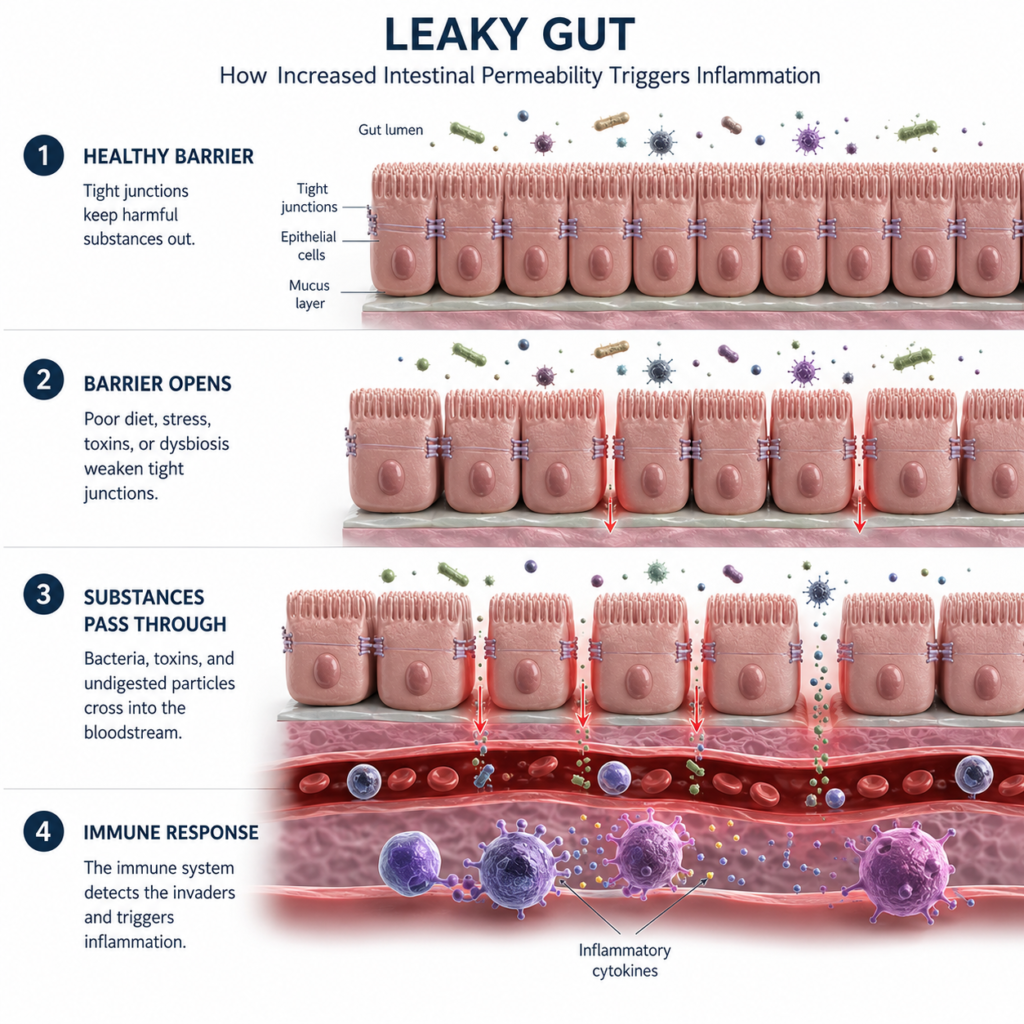
Few gut health terms are as widely used, and as widely misunderstood, as leaky gut. The confusion is understandable, because there are genuinely two different things hiding behind one phrase: increased intestinal permeability, which is real and measurable, and leaky gut syndrome, which is not a recognized medical diagnosis, according to the Cleveland Clinic.
The real, measurable part
Every gut is semi-permeable by design; the intestinal lining is meant to absorb nutrients and water while filtering out bacteria and larger particles. When the tight junctions between intestinal cells loosen beyond their normal range, permeability increases, and researchers can measure this directly using the lactulose or mannitol test, which tracks how much of two differently sized sugar molecules pass through the gut wall into urine, per a 2026 clinical explainer from Seed. Increased intestinal permeability is a recognized and well-documented feature of specific conditions, including inflammatory bowel disease, celiac disease, and certain infections, where researchers generally consider it a downstream symptom of chronic inflammation rather than the root cause.
The unrecognized, marketed part
Leaky gut syndrome, as it circulates in wellness content, extends this real but narrow phenomenon into a catch-all explanation for dozens of unrelated symptoms, from fatigue and brain fog to autoimmune disease and mood disorders. Wikipedia’s medical overview notes that claims for leaky gut syndrome as a distinct medical condition come mostly from nutritionists and alternative medicine practitioners rather than gastroenterology research, and a 2026 clinical review from Doctronic points out that consumer blood or stool kits marketed for diagnosing leaky gut, particularly those based on the protein zonulin, are not considered well validated by the clinical community, despite being sold as definitive tests.
Table 1. Intestinal permeability: the recognized phenomenon versus the marketed diagnosis.
| Term | Medically recognized? | What is actually known |
|---|---|---|
| Increased intestinal permeability | Yes | Measurable via lactulose/mannitol testing; a documented feature of IBD, celiac disease, and certain infections |
| Leaky gut syndrome | No | A catch-all term used by alternative practitioners to explain unrelated symptoms; not endorsed as a standalone diagnosis |
| Zonulin-based home test kits | Not well validated | Marketed as leaky gut diagnostics but lack clinical validation for that specific use |
3. Fermented Foods: The Stanford Study That Actually Moved the Needle
Few nutrition studies have reshaped gut health advice as directly as a 2021 clinical trial from Stanford Medicine, still widely cited as the clearest human evidence in this area. Researchers Justin and Erica Sonnenburg, along with nutrition scientist Christopher Gardner, randomly assigned 36 healthy adults to a 10-week diet emphasizing either fermented foods, such as yogurt, kefir, kimchi, and kombucha, or high-fiber foods, such as legumes, whole grains, and vegetables, and published the results in Cell.
The fermented food group saw a clear increase in overall microbial diversity, with the effect growing larger at bigger serving sizes, and a broad drop in inflammation: four types of immune cells showed reduced activation, and levels of 19 separate inflammatory proteins fell, including interleukin-6, a marker linked to rheumatoid arthritis, type 2 diabetes, and chronic stress. “This is a stunning finding,” said Justin Sonnenburg, describing it as one of the first demonstrations that a simple, specific dietary change can reproducibly reshape the microbiota across a group of healthy adults.
The high-fiber group, somewhat counterintuitively, did not show the same short-term improvement: microbial diversity remained largely stable and none of the 19 inflammatory markers dropped over the 10-week window. Erica Sonnenburg offered a plausible explanation rather than a dismissal of fiber’s value: a longer intervention, or the deliberate introduction of fiber-fermenting microbes alongside the fiber itself, may be needed before a fiber-rich diet produces the same measurable shift, a nuance worth holding onto before concluding fiber is somehow less important, a point covered directly in Section 4.
It provides one of the first examples of how a simple change in diet can reproducibly remodel the microbiota across a cohort of healthy adults. (Justin Sonnenburg, PhD, Stanford School of Medicine)
4. Fiber: The Most Underconsumed Nutrient in the Western Diet
Fiber has a strong claim to being the single most under-consumed nutrient in wealthy countries. National consumption surveys cited by the American Society for Nutrition found that only about 5% of men and 9% of women in the United States meet daily fiber recommendations, with average intake landing around 15 to 17 grams per day against a recommended 25 to 38 grams depending on age and sex. A related analysis in PMC puts the shortfall even more starkly: more than 90% of women and 97% of men in the United States fail to meet recommended fiber intakes.
Why fiber matters at the cellular level
Fiber that resists digestion in the small intestine reaches the colon, where gut bacteria ferment it into short-chain fatty acids, primarily acetate, propionate, and butyrate. Butyrate in particular functions as the primary fuel source for the cells lining the colon and plays a documented anti-inflammatory role: a 2025 review in Frontiers in Immunology describes how butyrate downregulates a specific pro-inflammatory signaling pathway involved in inflammatory bowel disease and helps maintain regulatory immune cells that keep inflammation in check. High dietary fiber intake reliably raises short-chain fatty acid levels and reduces markers of inflammation mediated through toll-like receptor signaling, per the same review.
An honest caveat: more fiber is not always better, immediately
Fiber’s reputation as an unconditional gut health fix deserves one nuance. In people with low baseline microbial diversity, or with conditions such as small intestinal bacterial overgrowth, a sudden large increase in fiber can temporarily worsen bloating and discomfort rather than help, because the bacterial population needed to ferment it efficiently has not yet developed. This is consistent with the Stanford trial’s fiber group showing no short-term diversity increase. The practical implication, echoed across clinical nutrition guidance, is to increase fiber gradually, in roughly five-gram weekly increments, alongside adequate water intake, rather than jumping from a low-fiber to a high-fiber diet overnight.
Table 2. Where dietary fiber typically falls short, and the daily targets clinical guidelines recommend.
| Group | Recommended daily fiber | Typical actual intake |
|---|---|---|
| Adult women (19 to 50) | 25 grams | Roughly 15 to 17 grams |
| Adult men (19 to 50) | 38 grams | Roughly 15 to 17 grams |
| Adult women (51+) | 21 grams | Below target for most |
| Adult men (51+) | 30 grams | Below target for most |
5. Inflammation: The Common Thread Connecting Gut Health to the Rest of the Body
Inflammation is where the microbiome, fiber, fermented foods, and intestinal permeability all converge. When gut bacterial diversity drops and the intestinal barrier weakens, bacterial compounds such as lipopolysaccharide, a component of certain bacterial cell walls, can translocate into the bloodstream and trigger a low-grade, chronic immune response. A 2026 narrative review in Frontiers in Microbiomes describes how this mechanism, alongside chronic immune activation and disrupted regulatory T-cell balance, is now implicated in rheumatological disease, and how gut microbial signaling extends even into pregnancy through what researchers term the gut-placenta axis.
This is not a fringe theory. Reduced gut microbial diversity and depletion of short-chain fatty acid-producing bacteria show up consistently across inflammatory bowel disease, metabolic syndrome, cardiovascular disease research, and increasingly in neurological and autoimmune conditions. The through-line across nearly all of this research is the same short list of levers: greater dietary diversity, adequate fiber intake, and regular inclusion of fermented foods, each of which independently supports the bacterial populations that keep this inflammatory signaling in check.
6. Ancient Wisdom, Modern Proof: Fermentation Across Civilizations
Fermentation is not a wellness trend with a start date. It is one of the oldest food technologies humans have developed, with evidence of fermented beverages in Neolithic pottery in China dating back more than 9,000 years, according to a historical overview from Loving Foods. What makes this history unusually convincing from a scientific standpoint is not its age alone but its independence: cultures with no contact with one another arrived at the same basic solution repeatedly, using whatever local ingredients were available.
Korean kimchi traces back roughly 4,000 years, as documented in the Sikyung, an ancient Chinese book of poetry, according to a historical review in PMC. German sauerkraut, milk kefir from the North Caucasus, Japanese miso, Ethiopian injera, and fermented cacao among the Olmec and Maya all developed independently, driven initially by food preservation needs rather than any theory of gut health, per a historical summary from An Oasis of Healing. European sailors specifically valued sauerkraut for its vitamin C content in preventing scurvy on long voyages, centuries before anyone understood the underlying nutritional chemistry.
This is a case where the Stanford research from Section 3 does not just support the practice in the abstract, it validates the specific foods these traditions independently converged on: yogurt, kefir, kimchi, and fermented vegetables were the exact category of foods shown to increase microbial diversity and lower inflammation markers in a controlled human trial. Roughly 5,000 distinct fermented foods are consumed across the world today, according to a comprehensive historical review in Springer Nature, nearly all developed long before the term microbiome existed.
One caution is worth carrying forward from history into the present: not all fermented products sold today deliver the same benefit their ancestors did. Many mass-produced, pasteurized versions of traditionally fermented foods are heated after fermentation specifically to extend shelf life, a process that kills the live bacterial cultures responsible for the microbiome benefits described in Section 3. A product labeled kimchi or sauerkraut on a supermarket shelf is not automatically equivalent to the unpasteurized, living version its name implies.
7. Marketing vs. Medicine: Sorting Gut Hype from Gut Evidence
Gut health has become one of the most commercially aggressive corners of wellness, and the size of the market does not track the size of the evidence base behind many of its best-selling products.
Colon cleanses and detox teas: a theory from a century ago, still unproven
Colon cleansing, using laxatives, teas, powders, or irrigation to supposedly remove toxins from the digestive tract, actually dates back to ancient Greece and became popular in the United States in the early 1900s, built on a theory called autointoxication, per WebMD. That theory lost mainstream scientific support decades ago and has not regained it. A gastroenterologist at MD Anderson states plainly that there is no proof colon cleansing prevents disease or improves health, and that regular cleansing risks removing the beneficial bacteria that keep the gut healthy rather than removing anything harmful. The global detox products market, spanning teas, powders, and supplements, was valued at over 66 billion dollars in 2024 despite the National Center for Complementary and Integrative Health, part of the NIH, finding little to no scientific evidence behind the most popular methods, according to a 2026 market and evidence review from Coldture, which also notes the FDA and FTC have taken legal action against multiple detox supplement companies for unproven disease claims.
Probiotics: real evidence, but only strain by strain
Probiotic supplements are frequently marketed as a single, interchangeable category, buy any probiotic and get the benefit. The clinical evidence says otherwise. An international evidence-based guide on probiotics published in PMC states directly that results obtained with one probiotic strain are not generalizable to others, meaning a product’s benefit for, say, antibiotic-associated diarrhea cannot be assumed to transfer to an entirely different strain marketed for bloating or immunity. A position statement from the Malaysian Society of Gastroenterology and Hepatology reinforces this, recommending that clinicians and consumers evaluate probiotic products by specific, named strain and documented evidence rather than by the broad category label on the front of the package. This does not mean probiotics are ineffective; robust evidence exists for specific, well-studied strains such as Lactobacillus rhamnosus GG for certain diarrheal conditions. It means the specific strain listed in small print matters far more than the word probiotic in large print.
A side-by-side comparison
Table 3. Popular gut health claims and products ranked by how strong the current evidence actually is.
| Claim or product | Evidence status | What is actually known |
|---|---|---|
| Fermented foods for microbiome diversity | Strong | Randomized Stanford trial directly measured increased diversity and reduced inflammation |
| Adequate fiber intake for gut and metabolic health | Strong | Large cohort and mechanistic evidence via short-chain fatty acid production |
| Strain-specific probiotics for a matched condition | Strong, but narrow | Effective when strain and condition are matched to clinical trial evidence |
| Increased intestinal permeability in IBD or celiac disease | Strong | Measurable and well documented as a feature of these specific conditions |
| Generic probiotic supplements for general gut health | Preliminary, inconsistent | Benefit is strain-specific; broad category claims outrun the evidence |
| Leaky gut syndrome as a standalone diagnosis | Not recognized | Not endorsed as a distinct medical condition by mainstream gastroenterology |
| Colon cleanses and detox teas | Not supported | NIH, FDA, and FTC find little to no evidence; may remove beneficial bacteria |
None of this is a reason to disengage from gut health as a topic, it is one of the more genuinely productive areas of modern medicine. It is a reason to ask, before buying a product built around the word gut, whether the specific claim has trial evidence behind it or whether it is borrowing credibility from the field’s real successes.
8. What Actually Helps: A Practical Summary
Pulling the evidence above into a working list, the interventions with the strongest support share a common thread: they feed a diverse bacterial population rather than trying to eliminate or bypass it.
- Aim for plant diversity over any single superfood: research consistently favors a wide range of different fiber sources, roughly 30 different plant foods a week is the benchmark cited in several large cohort studies, over any single fiber-rich item eaten repeatedly.
- Include a genuinely live fermented food most days: unpasteurized yogurt, kefir, kimchi, sauerkraut, or miso, checking labels for live or active cultures, since pasteurized versions lack the bacteria responsible for the Stanford trial’s results.
- Increase fiber gradually rather than all at once, especially if current intake is low, to avoid the bloating that leads many people to wrongly conclude fiber does not agree with them.
- Treat persistent digestive symptoms, severe bloating, blood in stool, unintended weight loss, as a reason to see a gastroenterologist, not a reason to start an unproven cleanse or elimination protocol.
- Choose probiotic supplements, if used, by specific named strain matched to a specific documented benefit, rather than by marketing claims on the front of the package.
Gut health research has produced some of the more genuinely useful findings in recent nutrition science, and unlike many wellness categories, several of its core claims now rest on real randomized trial data rather than correlation alone. Microbial diversity matters, fermented foods measurably support it, fiber remains chronically under-consumed relative to what the evidence recommends, and chronic low-grade gut-driven inflammation is a real, mechanistically understood contributor to disease well beyond the digestive tract. What the evidence does not support is treating every symptom as a gut problem, every supplement labeled probiotic as equally effective, or old anxieties about toxins repackaged as a modern colon cleanse. The foods that show up in both the oldest culinary traditions and the newest clinical trials, largely plants, fiber, and living fermented foods, remain the most consistently supported answer available.
Sources & Further Reading
- Gut Microbiota for Health, Key advances in gut microbiome research during 2025
- Frontiers in Microbiology, The human gut microbiota is associated with host lifestyle: a comprehensive narrative review (2025)
- ScienceDaily, Scientists discover a hidden gut bacterium linked to good health (2026)
- Cleveland Clinic, Leaky Gut Syndrome: Symptoms, Diet, Tests & Treatment
- Wikipedia, Leaky gut syndrome
- Doctronic, Leaky Gut Syndrome: Real Condition or Myth? What Science Says (2026)
- Seed, Is Leaky Gut Real? The Science of Intestinal Permeability
- Stanford Medicine, A fermented-food diet increases microbiome diversity and lowers inflammation, study finds (2021)
- American Society for Nutrition, Most Americans are not getting enough fiber in our diets
- PMC, The Dietary Guidelines for Americans (2020 to 2025): Pulses, Dietary Fiber, and Chronic Disease Risk
- Frontiers in Immunology, The role of short-chain fatty acids in metabolic syndrome and its complications (2025)
- Frontiers in Microbiomes, Understanding the human gut microbiome: from composition to disease association (2026)
- Loving Foods, The Ancient Art of Fermentation
- PMC, From Ancient Fermentations to Modern Biotechnology: Historical Evolution of Fermented Foods
- An Oasis of Healing, History and Introduction of Fermentation
- Springer Nature, Food Fermentation and Its Relevance in the Human History
- WebMD, Natural Colon Cleansing & Detox: Is It Necessary?
- MD Anderson, Colon cleanse: Health or hype?
- Coldture, 3 popular detox methods the NIH says have little to no scientific evidence behind them (2026)
- PMC, Systematic review: probiotics in the management of lower gastrointestinal symptoms, an evidence-based international guide
- PMC, Use of probiotics in clinical practice with special reference to diarrheal diseases: Malaysian Society of Gastroenterology and Hepatology position statement
This article is for general informational purposes and does not constitute medical advice. Speak with a qualified healthcare provider, such as a gastroenterologist or registered dietitian, before making significant changes to diet, supplementation, or fiber intake, particularly if you manage a digestive or autoimmune condition.