

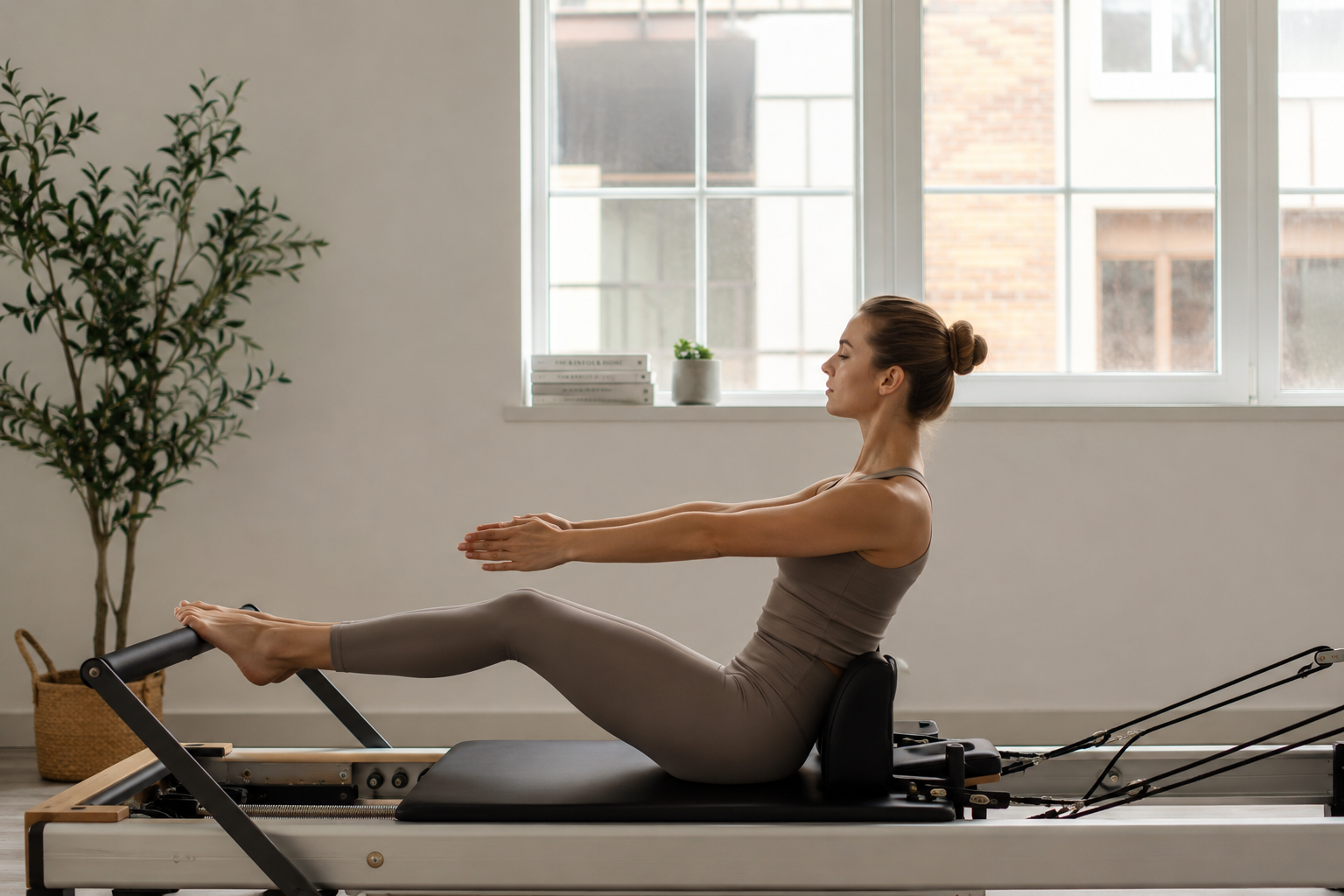
The real story behind the method, what the research actually shows about your core, your posture, and your mind, and why a practice invented in a WWI internment camp is now a global industry.
By the Repeat Editorial Team Medically informed, evidence-based
| TL;DR THE 60-SECOND VERSION |
| • Pilates was invented by Joseph Pilates, a sickly German-born child who grew into a boxer and gymnast, and who developed the method’s foundations while interned in a World War I prisoner camp on the Isle of Man. He called it Contrology. |
| • Global participation has grown to more than 36 million active practitioners across roughly 55,000 studios worldwide as of 2024, with class attendance rising 17% in a single year, driven by athletes, physical therapists, and a wave of celebrity and social media visibility. |
| • The method’s core claim holds up under research: a 2023 meta-analysis of 34 randomized controlled trials found Pilates outperformed general exercise programs for improving core endurance, balance, and pain scores across multiple populations. |
| • Pilates specifically trains the deep stabilizing muscles most workouts miss, the transversus abdominis, multifidus, pelvic floor, and diaphragm, the muscular unit that braces the spine before any limb even moves. |
| • It is now a standard tool in physical therapy for chronic low back pain, with multiple randomized trials showing meaningful reductions in pain and disability, particularly when added to conventional treatment. |
| • Evidence for older adults is genuinely mixed and worth being honest about: Pilates reliably improves balance in randomized trials, but there is not yet solid proof it reduces the number of actual falls. |
| • Reformer Pilates is generally considered the more physically demanding, resistance-based version of the method, while mat Pilates is the original, equipment-free form Joseph Pilates taught first, and most of the underlying research applies to both. |
There is a decent chance you know someone who has, at some point in the last few years, said some version of the phrase I do Pilates now with the quiet conviction of someone who has found religion. Maybe that someone is you. It is a strange thing to watch a hundred-year-old exercise method, invented by one man in a prison camp with no equipment, spring boards, or app subscriptions to speak of, become one of the fastest-growing categories in the entire wellness industry. But that is roughly what has happened.
This article tells that story properly, from the actual man behind the name to what current research has to say about the muscles, the posture, and even the mood benefits people talk about after a class. It also gives an honest look at where the evidence is genuinely strong and where it is still catching up to the hype, because a method this popular deserves a clear-eyed answer rather than another glowing testimonial.
1. What Is Pilates?
Pilates is a system of controlled, low-impact exercises built around core strength, breath, and precise movement, performed either on a mat or on specialized spring-resistance equipment. It was created by Joseph Hubertus Pilates, born in 1883 near Mönchengladbach, Germany, to a father who was a prize-winning gymnast and a mother who practiced naturopathy. Joseph was a famously unwell child, dealing with asthma, rickets, and rheumatic fever, and according to his Wikipedia biography, he spent much of his life determined to build the strength his body had denied him early on, immersing himself in gymnastics, boxing, and martial arts by his teenage years.
A method born in a prison camp
Here is the part of the story that tends to surprise people. When World War I broke out, Joseph was living in England, and as a German national, he was classified as an enemy alien and interned, first at Lancaster Castle and later at Knockaloe Camp on the Isle of Man, a facility that at its peak held more than 24,000 men, according to a detailed historical account in Narratively. Rather than let confinement dull him, Joseph treated the camp as a kind of laboratory. He trained fellow internees in wrestling and self-defense, studied the way stray camp cats moved, lithe and efficient despite being scrawny, and started building a system of exercises he would later call Contrology, a name meant to capture the idea of the mind consciously controlling the muscles, rather than movement happening on autopilot.
The often-repeated detail about the origin of the Reformer, the spring-loaded machine now synonymous with the method, is that Joseph rigged springs to hospital bed frames so bedridden, injured prisoners could exercise while still lying down. A thorough modern review of the historical record from Corevapilates notes that this story is treated as credible by his biographers, though it is not fully confirmed by surviving camp documents, a reasonable reminder that even well-loved origin stories deserve a little healthy skepticism. What is well documented is that Joseph filed the Reformer’s foundational patent in 1924 and, after emigrating to New York in 1926, opened a studio at 939 Eighth Avenue with his partner Clara, where dancers, boxers, and circus performers became his earliest and most devoted clients.
How it differs from a typical workout
Where most traditional workouts isolate individual muscles or chase fatigue through repetition, Pilates asks you to move the whole body with deliberate control, guided by breath and precise alignment rather than speed or heavy load. Joseph Pilates built the method around six core principles, concentration, control, centering, flow, precision, and breathing, and he considered Contrology less a workout than a way of living. That framing still holds up reasonably well against modern exercise science: Pilates is fundamentally a neuromuscular training method, teaching the nervous system to recruit the right muscles in the right order, rather than a pure strength or cardio program in the traditional sense.
2. Why Pilates Has Grown So Rapidly
The numbers here are genuinely striking for a hundred-year-old exercise method. As of 2024, there were more than 55,000 Pilates and yoga studios worldwide with over 36 million active participants, a 14% increase compared with 2020, according to market data compiled by Industry Research, with global class attendance rising 17% in a single year. The combined Pilates and yoga studio market was valued at well over 100 billion dollars in 2025 across multiple independent industry analyses, with consistent double-digit annual growth projected through the early 2030s.
Several forces are converging at once. Physical therapists have quietly used Pilates-based exercises for decades, which gave the method medical credibility long before it became fashionable. Dancers and athletes never really left; George Balanchine, the legendary choreographer, was reportedly taken enough with the method’s flowing control that he incorporated it into one of his own ballets. Add in a wave of celebrity practitioners, an entire genre of social media content built around reformer workouts, and a growing body of research validating what practitioners had been saying anecdotally for years, and you get the current moment: a market that industry analysts expect to keep growing well into the next decade, with participation broadening beyond its historically female-dominated base as more men, older adults, and rehabilitation patients take it up.
3. The Science Behind Core Strength
When people say Pilates is good for your core, it’s worth being specific about what that actually means, because the core most workouts target and the core Pilates targets are not quite the same thing. A clinical explainer describes the deep core unit as a cylindrical structure made up of four muscle groups working together, the transversus abdominis, the multifidus running along the spine, the pelvic floor, and the diaphragm, according to Peak Primal Wellness. When these four contract together, they create intra-abdominal pressure, a natural internal brace that stabilizes the spine before you even move a limb, and Pilates is built specifically to teach the nervous system to activate this unit with precision.
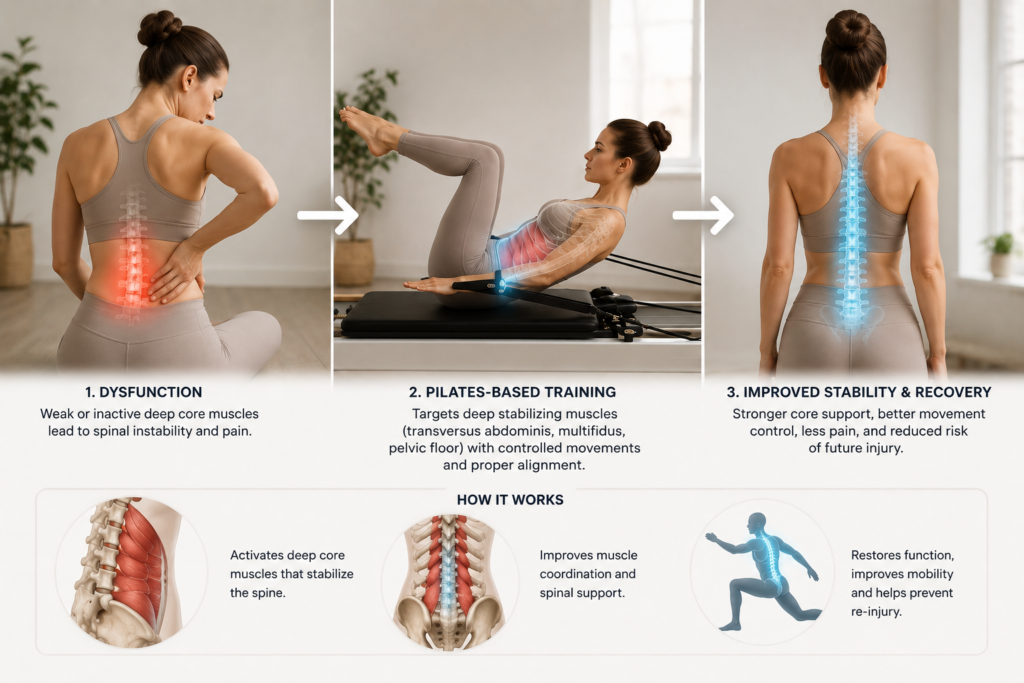
This is not just a nice theory. A 2023 meta-analysis reviewing 34 randomized controlled trials confirmed that Pilates interventions outperformed general exercise programs for improving core endurance, balance, and pain scores across multiple populations, per the same source. The same body of research consistently identifies the transversus abdominis and multifidus as being under-recruited in people with chronic low back pain, and Pilates-style movements are specifically designed to retrain the coordination between these muscles, an approach a review in PMC describes as functionally similar to clinical spinal stabilization exercise, the kind physical therapists use directly for back pain rehabilitation.
Why this matters beyond the studio
A stronger deep core isn’t just about how a plank feels. It shows up in how well your spine tolerates the unglamorous stresses of daily life, bending to pick something up off the floor, twisting to grab a bag from the back seat, standing for a long stretch without your lower back complaining. That everyday carryover is a big part of why physical therapists reach for Pilates-style exercises specifically, rather than generic ab workouts, when someone comes in with back pain.
4. Improving Mobility and Flexibility
Pilates has always leaned into full, controlled ranges of motion rather than the shorter, more repetitive movement patterns common in many strength programs. A comparative overview from Peak Primal Wellness notes that both mat and reformer Pilates incorporate dynamic stretches and controlled movements specifically designed to stretch and lengthen working muscles, contributing to a more fluid range of motion that carries over into daily movement and athletic performance alike.
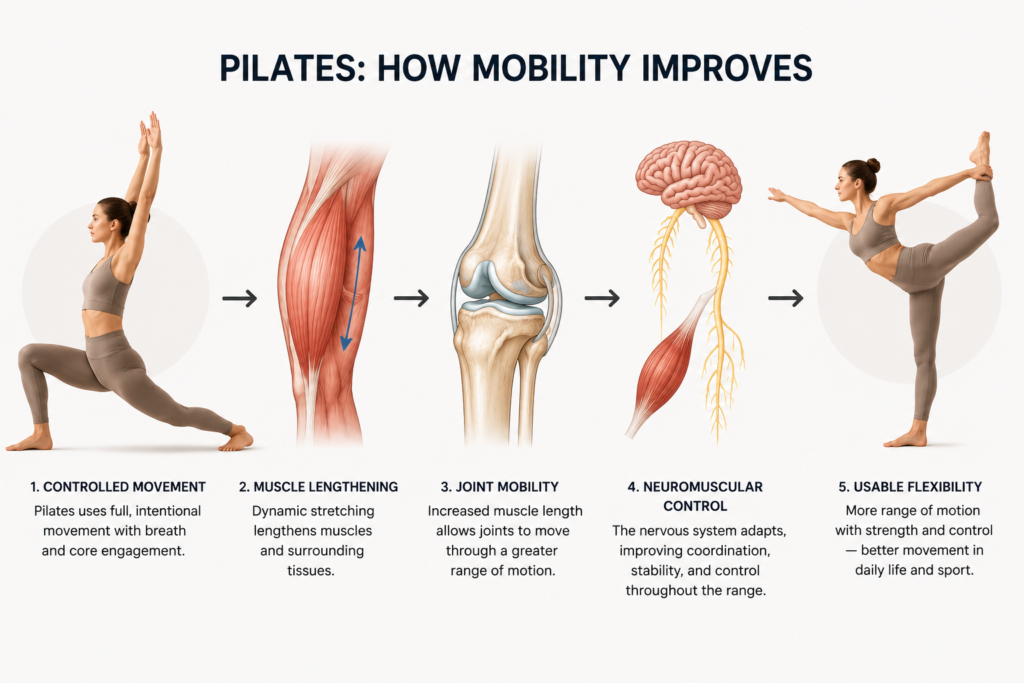
What sets Pilates apart from static stretching alone is that the flexibility gained tends to be usable flexibility. Because every movement is paired with core control and a deliberate breath pattern, the joints are moving through a bigger range while the surrounding muscles stay engaged, rather than passively loose. That combination, more range of motion without giving up control over it, is part of why Pilates rarely leaves people feeling overworked or strained the way a hard cardio or heavy lifting session can, even after a genuinely challenging class.
5. Better Posture and Body Alignment
If you spend your day hunched over a laptop, there is a good chance your hip flexors are tight, your upper back is rounded, and your deep core has essentially gone on strike. Pilates was, in a sense, built for exactly this problem, decades before remote work made it a near-universal one. Joseph Pilates himself believed that modern lifestyles, poor posture, and inefficient breathing were quietly undermining people’s health, a diagnosis that reads as strikingly current for something written closer to a century ago.
The mechanism is fairly intuitive once you see it laid out. Prolonged sitting shortens the hip flexors and weakens the glutes and deep abdominals, pulling the pelvis out of a neutral position and rounding the shoulders forward. Pilates directly targets this imbalance by strengthening the muscles that have gone quiet, the deep core and the postural muscles of the back, while stretching the ones that have gotten tight. A clinical review focused on chronic low back pain notes that Pilates promotes better body awareness and improves posture as a core part of how the method addresses pain, not as an incidental side effect.
This is also where the mind-body language around Pilates earns its keep rather than sounding like marketing filler. You cannot really do the exercises correctly without paying attention to where your spine, ribcage, and pelvis actually are in space, and that attention is itself the corrective mechanism. Over weeks of practice, that awareness tends to start showing up outside of class too, in how you sit at your desk or stand in line at the store.
6. Injury Prevention and Rehabilitation
This is arguably where Pilates has the most solid research behind it, and it’s not a coincidence. Physical therapists have used Pilates-based exercise for chronic low back pain for decades, long before it had any cultural cachet, precisely because the movements map so directly onto clinical spinal stabilization work. A randomized controlled trial published in the Irish Journal of Medical Science investigating Pilates in the management of subacute low back pain found that structured, supervised Pilates sessions helped improve muscle activation and coordination in the transversus abdominis and multifidus, the exact muscles most commonly dysfunctional in people with back pain, while also noting that the supervised, structured nature of the sessions likely improved patient adherence compared with unsupervised home exercise.
The research extends well beyond back pain. A protocol for a multi-center randomized controlled trial published in BMC Neurology describes Pilates-based core stability training being tested specifically for people with multiple sclerosis, building on earlier case-series evidence that the approach could improve balance and mobility in that population, a strong signal for how broadly clinicians now consider the method applicable in rehabilitation settings, not just for otherwise-healthy people seeking a good workout.
7. Pilates for Mental Wellbeing
Ask a longtime Pilates practitioner why they keep coming back, and the answer often has surprisingly little to do with their abs. It’s the forty-five minutes where their mind was fully occupied by their own breath and movement, and the outside world, for once, wasn’t. That is not just a nice feeling; there’s a real physiological story behind it.
Pilates breathing is deliberately structured, typically a pattern of lateral, ribcage-expanding inhales paired with controlled exhales timed to the hardest part of a movement. A clinical explainer on the mechanism notes that this kind of controlled, rhythmic breathing activates the parasympathetic nervous system, the body’s rest and digest mode, which directly counters the stress response by lowering heart rate and reducing circulating cortisol, according to a review of the evidence. The same review points to improved vagal tone, a marker of how well the nervous system recovers from stress, as a specific, trainable benefit of consistent Pilates breathing practice, and cites research showing regular practice measurably decreases depression and anxiety scores while improving overall psychological wellbeing.
None of this requires believing Pilates is a replacement for therapy or medication where those are genuinely needed. What the research does support is something more modest and, honestly, more useful: a form of exercise that asks for your full attention, paired with a breathing pattern that calms your nervous system on a physiological level, tends to leave people feeling steadier, not just stronger.
8. Who Can Benefit from Pilates?
Part of why Pilates has spread so far beyond dance studios and physical therapy clinics is that it genuinely does scale to very different bodies and goals, more so than most fitness methods can honestly claim.
- Beginners find an accessible entry point, since intensity and range of motion can be dialed up or down without changing the exercise itself, and there is no barbell to be intimidated by on day one.
- Older adults benefit from the balance and postural stability focus described in Section 5, though it’s worth being upfront that the evidence here is more nuanced than marketing suggests, a point covered honestly in the table below.
- Athletes across sports use Pilates as a low-impact way to build the core control and hip stability that support performance in their primary sport without adding another day of high-impact training.
- Office workers and anyone dealing with the effects of prolonged sitting get a direct answer to the postural imbalances described in Section 5.
- People recovering from injury are among the method’s original audience, and it remains a mainstay of physical therapy for exactly the reasons covered in Section 6.
- Pregnant women can benefit from modified Pilates focused on pelvic floor and core awareness, though this is a case where professional guidance genuinely matters: certain traditional exercises need to be adapted or avoided by trimester, and a review in ScienceDirect specifically flags a paucity of high-quality evidence on Pilates during pregnancy, meaning the safest path is a prenatal-certified instructor rather than a generic class or an app.
9. Mat Pilates vs. Reformer Pilates
Mat Pilates is the original form, the version Joseph Pilates taught in the internment camp and later refined into the exercises documented in his own books. It uses only body weight and gravity for resistance, which makes it accessible, affordable, and a genuinely solid foundation before adding equipment. Reformer Pilates uses the spring-and-pulley machine that grew out of Joseph’s camp-era improvisations, adding adjustable resistance that can make an exercise significantly harder, or, just as usefully, easier for a beginner or someone in rehab, according to a comparison from Village Gym.
The research comparing the two directly is still fairly limited, but what exists is instructive. A study described in Frontiers in Physiology notes that the reformer apparatus provides mechanical assistance, which makes it easier for novices to activate the correct target muscles, while mat-based exercises require you to generate and control all of that force yourself, meaning muscle activation on the mat depends more heavily on a practitioner’s skill level and experience. Neither format is simply better in the abstract; they emphasize slightly different things.
Table 1. Mat Pilates vs. Reformer Pilates, at a glance.
| Mat Pilates | Reformer Pilates | |
|---|---|---|
| Equipment needed | Just a mat, sometimes small props | Spring-loaded reformer machine |
| Resistance source | Body weight and gravity only | Adjustable springs, can be increased or reduced |
| Best for beginners | Very accessible, but form relies more on the practitioner | Machine assistance can make correct muscle activation easier |
| Cost and access | Low cost, can be done almost anywhere | Typically requires a studio and higher class prices |
| Where it shines | Building foundational control and body awareness | Rehabilitation, added resistance, more exercise variety |
If you are weighing which to start with, the honest answer is that either is a reasonable entry point, and a lot of practitioners eventually do both. Mat Pilates builds the control and body awareness that make reformer sessions more effective later, while reformer classes offer a wider exercise library and more precisely adjustable resistance, which some people find keeps them more engaged over the long run.
A Few Honest Notes Before Your First Class
If everything above has you curious enough to actually try it, a few practical things are worth knowing that most glossy studio websites tend to skip over.
- It is genuinely harder than it looks. Pilates videos, especially reformer content online, are edited to look serene and effortless. The reality of holding a controlled position for thirty seconds while breathing precisely is a real workout, and most first-timers are surprised by how sore they are the next day.
- A good instructor matters more than the format. Given how much of the benefit comes from precise muscle activation rather than just going through the motions, working with a qualified teacher, at least for your first several sessions, tends to produce far better results than following along with a video alone.
- Consistency beats intensity here as much as anywhere else. The research summarized throughout this article generally involves sessions two to three times a week over six to eight weeks before meaningful changes in strength, balance, or pain show up, not a single transformative class.
- It pairs well with other training rather than replacing it. Pilates is not typically a substitute for cardiovascular exercise or heavier resistance training; it works best alongside them, filling in the core control and mobility work those other methods often leave out.
10. Why Pilates Is More Than a Fitness Trend
It’s worth being clear-eyed about where the evidence is still catching up, alongside everywhere it’s strong. A comprehensive systematic review and meta-analysis in PubMed found robust evidence that Pilates improves both static and dynamic balance in older adults. But a separate, more skeptical review in the same body of research notes there is not yet solid evidence that Pilates actually reduces the number of falls people experience, as opposed to simply improving the balance measures researchers use as a proxy for fall risk. That is a genuinely useful distinction, and one worth holding onto rather than assuming every plausible-sounding benefit has been fully proven just because the underlying mechanism makes sense.
Physical fitness is the first requisite of happiness. (Joseph Pilates)
What tends to separate Pilates from the fitness trends it has outlasted, jazzercise, shake weights, whatever the current TikTok challenge is, is that it was never actually built as a trend to begin with. Joseph Pilates spent roughly five decades refining a single, coherent system, one grounded in anatomy, breath, and a genuine theory of how bodies move well, and he kept teaching it into his eighties, past the point where he could still demonstrate every exercise himself. The version of Pilates filling studios today has absorbed reformers, apps, and a great deal of social media polish since then, but the underlying premise, that a strong, coordinated core changes how the rest of your body moves and feels, has held up remarkably well against a century of scrutiny it was never originally built to survive. That is a much higher bar than most fitness fads ever have to clear, and it’s a reasonable part of why people who try it tend to stick around.
Pilates did not become a global phenomenon by accident, and it did not do it purely on the strength of good marketing either, though it has certainly had plenty of that lately. It grew out of one unusually determined man’s decades-long obsession with understanding how bodies actually work, tested in a wartime prison camp long before it ever reached a boutique studio, and it has since accumulated a genuinely solid body of clinical research behind its core claims: better deep core function, improved posture, real rehabilitation value, and a calming effect on the nervous system that shows up in more than just how people feel in the moment. It is not a miracle cure, and the evidence for a few of its more ambitious claims, particularly around falls prevention in older adults, is still catching up to the enthusiasm. But as a long-term practice for moving better, standing straighter, and feeling steadier in your own body, Pilates has earned its place well beyond the trend cycle.
Thinking about giving Pilates a try? Explore Repeat’s Pilates service to learn more about the practice, what to expect, and how to take your first step with confidence.
Sources & Further Reading
- Wikipedia, Joseph Pilates: biography and history
- Narratively, The acrobatic immigrant who invented Pilates in a prisoner of war camp
- Corevapilates, History of Pilates: Joseph Pilates and Contrology (2026)
- APPI Clinics, The origins of Pilates
- Pilates Anytime, Pilates history: who was Joseph Pilates?
- Industry Research, Pilates and Yoga Studios Market Report (2026)
- IMARC Group, Pilates and Yoga Studios Market
- Peak Primal Wellness, Pilates for core strength and stability
- PMC, The efficacy of the addition of the Pilates method over a minimal intervention in the treatment of chronic nonspecific low back pain
- Peak Primal Wellness, Mat Pilates vs. Reformer Pilates
- Irish Journal of Medical Science, Preventing chronic low back pain: investigating the role of Pilates in subacute management, a randomized controlled trial (2025)
- BMC Neurology, Pilates based core stability training in ambulant individuals with multiple sclerosis: protocol for a multi-centre randomised controlled trial
- Inspire Atlanta, The science behind Pilates and mental health (2026)
- Village Gym, Reformer Pilates vs mat Pilates: which is more effective?
- Frontiers in Physiology, Comparisons of functional movements and core muscle activity in women according to Pilates proficiency (2024)
- PubMed, The effectiveness of Pilates training interventions on older adults’ balance: a systematic review and meta-analysis of randomized controlled trials (2023)
- PMC, Pilates reducing falls risk factors in healthy older adults: a systematic review and meta-analysis
- ScienceDirect, Effect of Pilates exercise for improving balance in older adults: a systematic review with meta-analysis
