
What current research actually shows about resistance training, muscle, fat loss, ancient strength culture, and the myths that keep people away from heavy weights.
By the Repeat Editorial Team Medically informed, evidence-based
| TL;DR THE 60-SECOND VERSION |
| • Strength training is exercise that applies resistance, weights, bands, or body weight, to build muscular force and size, distinct from cardio, which primarily trains the heart and lungs to sustain aerobic effort over time. |
| • Muscle is metabolically active tissue involved in movement, posture, blood sugar regulation, and resting calorie burn; losing it is one of the more consequential and preventable parts of aging. |
| • Roughly 30 to 60 minutes of muscle-strengthening exercise per week is associated with a 10 to 20% reduction in all-cause mortality in large cohort studies, independent of cardio. |
| • The core mechanism behind visible progress is progressive overload, a principle first documented in legend around 500 BCE and confirmed repeatedly in modern hypertrophy research. |
| • Muscle mass improves insulin sensitivity and glucose disposal directly, which is why building muscle supports fat loss in a way that goes beyond calories burned during the workout itself. |
| • “Toning” is not a distinct physiological process, and lifting heavy weights will not make most women bulky; both are among the most persistent, least accurate ideas in fitness. |
| • Supervised, coached training reliably produces greater strength and body composition improvements than the same program done alone, according to multiple randomized controlled trials comparing the two approaches directly. |
Of all the interventions covered across Repeat’s health content, strength training may have the widest gap between how well-established its evidence is and how inconsistently people actually practice it. Cardiovascular exercise gets most of the public attention as the default form of movement, and resistance training is still frequently treated as optional, or as something reserved for athletes and bodybuilders rather than something every adult body benefits from directly.
The research says otherwise, clearly and repeatedly. This article walks through what strength training actually is, why muscle functions as far more than an aesthetic feature, what the evidence shows about fat loss, effective programming, and common mistakes, why supervised coaching measurably outperforms training alone, and why some of the oldest recorded training principles in human history are still the foundation of modern sports science.
1. What Is Strength Training?
Strength training, also called resistance training, refers to any form of exercise in which muscles work against an external load, whether that load comes from free weights, weight machines, resistance bands, or an individual’s own body weight, with the goal of increasing muscular strength, size, or endurance. The defining feature is progressive resistance: the muscle is asked to produce more force than it is accustomed to, which triggers the adaptations covered in Section 5.
How it differs from cardio
Cardiovascular exercise, running, cycling, swimming, and similar sustained aerobic activities, primarily trains the heart, lungs, and circulatory system to deliver oxygen efficiently over an extended period. Strength training instead targets the neuromuscular system directly: the nerves that recruit muscle fibers and the muscle fibers themselves. The two forms of training produce meaningfully different adaptations, cardio primarily improves VO2 max and aerobic capacity, while resistance training primarily improves force production, muscle cross-sectional area, and bone density, and the research consistently finds that a well-rounded fitness program benefits from both rather than treating them as interchangeable or as one replacing the need for the other.
A brief note on muscle fiber types
Part of why strength and endurance training feel so different is that they preferentially recruit different types of muscle fiber. Type I fibers, sometimes called slow-twitch, are fatigue-resistant and built for sustained aerobic effort, the kind cardio depends on. Type II fibers, or fast-twitch, generate far more force per contraction but fatigue quickly, and they are the primary fibers recruited during heavy resistance training. A 2021 review in the International Journal of Molecular Sciences notes that Type II fibers have narrower, weaker structural components than Type I fibers, which is part of the reason they sustain more microscopic damage during unaccustomed or eccentric loading, the specific mechanism behind the muscle soreness discussed in Section 6.
2. Why Muscle Matters
Muscle is often discussed as a purely aesthetic feature, which understates its actual biological role considerably. Skeletal muscle is the body’s largest glucose storage site and a primary destination for blood sugar after a meal; it is also metabolically active at rest, meaning a person with more muscle mass burns more calories doing nothing at all than a person with less, a relationship covered in depth in Repeat’s metabolism article. Muscle additionally provides the structural support behind posture and joint stability, and it is the tissue responsible for every physical movement a person makes, from standing up from a chair to catching their balance after a stumble.

The scale of muscle’s importance becomes clearer with age. Large cohort research indicates that 30 to 60 minutes of muscle-strengthening activity per week is associated with a 10 to 20% reduction in all-cause mortality, according to a summary of the literature in Scientific American, and that benefit compounds further when resistance training is combined with cardio, which is the pattern Repeat’s longevity article also identifies as the strongest lifestyle predictor of a long healthspan.
3. Key Benefits of Strength Training
The evidence base for resistance training spans several distinct systems in the body, not just muscle size.
Strength and function
The most direct benefit is simply the ability to produce more force, which translates to easier daily tasks: carrying groceries, climbing stairs, getting up off the floor. This functional carryover matters more, not less, as people age.
Bone health
Resistance training is one of the few interventions shown to directly improve bone mineral density rather than simply slow its decline. A 2025 systematic review and meta-analysis in PMC found that resistance training significantly improved bone mineral density at the lumbar spine, femoral neck, and total hip in postmenopausal women, a population at particularly elevated risk of osteoporosis, a topic also covered in Repeat’s women’s hormones article.
Posture and joint health
Strengthening the muscles that support the spine and shoulders directly improves postural control, and stronger muscles around a joint reduce the load that joint has to absorb on its own, which is part of why resistance training is now a standard component of rehabilitation for chronic joint pain rather than something to avoid around an injury.
Energy and body composition
Resistance training improves body composition, the ratio of muscle to fat, more reliably than weight alone reflects, a distinction covered in depth in Repeat’s metabolism article. Many people also report improved daily energy levels with consistent training, plausibly linked to the same insulin sensitivity and sleep quality improvements documented elsewhere in this article.
Mental health and cognitive function
The benefits of resistance training extend beyond the musculoskeletal system. Research on exercise and mental health consistently finds that structured resistance training reduces symptoms of anxiety and depression, likely through a combination of improved sleep, reduced systemic inflammation, and the psychological effect of visible, measurable progress over time. Some research on older adults has specifically examined resistance training’s effect on brain structure, though findings here are more mixed than for muscle and bone: a study cited in a 2025 clinical trials database found no measurable long-term change in brain grey matter volume from resistance training in already-active older adults at retirement age, a useful reminder that not every proposed benefit of exercise is equally well supported, even where the underlying rationale is plausible.
4. Strength Training and Fat Loss
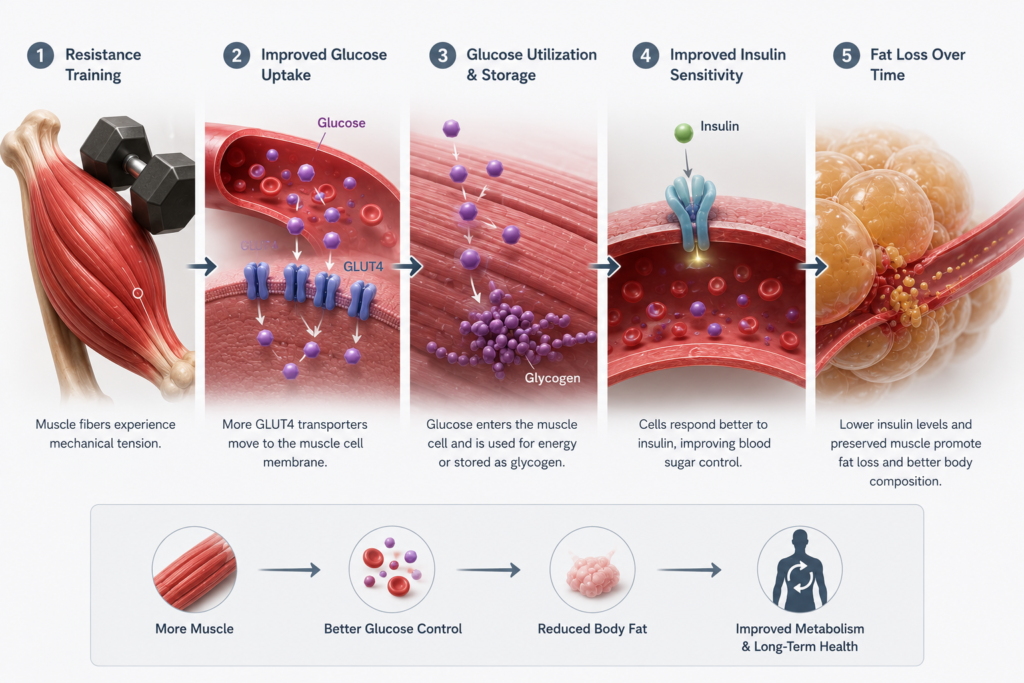
Strength training supports fat loss through mechanisms that extend well beyond the calories burned during the session itself. Muscle tissue is the primary site of insulin-mediated glucose disposal in the body, and more muscle mass means more capacity to clear glucose from the bloodstream efficiently, directly improving insulin sensitivity, the same mechanism discussed in Repeat’s metabolism article under metabolic flexibility. A 2025 trial in the Journal of Cachexia, Sarcopenia and Muscle found that adding high-intensity resistance and impact training during a weight-loss program in older adults with obesity improved physical function and body composition beyond what calorie restriction alone achieved, specifically by protecting against the muscle and bone loss that typically accompanies weight loss through diet alone.
A separate randomized comparison published in PMC found that participants training with a personal trainer showed a significant reduction in body fat that was not observed in groups training with a partner or alone, a finding covered further in Section 7.
This is the core reason resistance training is now recommended alongside, rather than instead of, dietary changes for sustainable fat loss: a calorie deficit achieved through diet alone tends to reduce both fat and muscle, while a calorie deficit paired with resistance training preferentially preserves muscle, which protects long-term metabolic rate and reduces the likelihood of regaining fat afterward.
5. The Science of Effective Training
The central mechanism behind visible strength and muscle gains is progressive overload: gradually increasing the demand placed on a muscle over time, whether through more weight, more repetitions, more sets, or improved technique that allows fuller muscle engagement. A direct experimental study described on PubMed found that muscle growth was more pronounced when resistance training was progressively overloaded compared with training at a constant load, though the same study noted that even training without overload progression was sufficient to produce some hypertrophy in untrained young women, meaning consistency itself carries real value even before optimization begins.
What the current research recommends
- Training intensity in the range of 60 to 85% of one-repetition maximum is consistently associated with strong hypertrophy outcomes across studies.
- A recent integrative review in the peer-reviewed literature identifies training volume, proximity to failure, and progressive overload as the three variables with the most consistent influence on muscle growth, ahead of more specific programming details.
- Research directly comparing load progression against repetition progression, increasing weight versus increasing reps at a fixed weight, has found both approaches produce comparable hypertrophy, suggesting the principle of overload matters more than the specific method used to apply it.
- Recovery is not optional. Structured rest days, adequate sleep, and sufficient protein intake are described across the literature as prerequisites for progression rather than optional extras, since muscle adaptation actually occurs during recovery, not during the training session itself.
Consistency and technique
Proper technique determines how much of the intended muscle actually receives the training stimulus, and poor form both increases injury risk and reduces the effectiveness of an exercise for its intended purpose. Consistency compounds this further: the research above assumes a program is followed over weeks and months, and the single biggest predictor of long-term results across the literature is simply sustained adherence to a reasonable program, not access to an unusually optimized one.
What actually happens inside a muscle cell
The visible outcome of progressive overload, a larger, stronger muscle, is the downstream result of a specific molecular pathway. A comprehensive 2021 review in the Journal of Neuromuscular Diseases describes how mechanical tension from resistance exercise activates a signaling complex called mTORC1, mechanistic target of rapamycin complex 1, which drives muscle growth at two levels simultaneously: it increases the rate of protein synthesis directly, and it stimulates the transcription of ribosomal RNA needed to build the cellular machinery that manufactures new muscle protein. The same review notes that hormones and mechanical signals from training can activate this pathway independently, and that mTORC1 signaling is now considered central to how resistance exercise is translated into actual tissue growth.
A second mechanism runs alongside this one: satellite cells, dormant muscle stem cells that sit against existing muscle fibers, activate in response to training and can fuse into those fibers, contributing additional nuclei that support larger fiber size over time. The same review notes that satellite cell involvement varies by hypertrophy model and is not considered strictly required for every form of muscle growth, but it remains one of the clearer examples of how resistance training prompts the body to build new cellular machinery rather than simply using existing tissue more efficiently, a genuinely different kind of adaptation than the one cardiovascular training produces.
What a well-designed week actually looks like
- Two to three resistance training sessions per week, covering all major muscle groups, is sufficient for most people to see meaningful strength and body composition change over a few months.
- Compound movements, squats, deadlifts, presses, and rows, that recruit multiple muscle groups at once tend to produce the most efficient return per session for general strength and health goals.
- A rep range of roughly 6 to 15 repetitions per set, taken close to but not always all the way to muscular failure, covers most of the range shown to support both strength and hypertrophy in the research above.
- Progression should be tracked deliberately, adding small increments of weight, reps, or sets every one to two weeks, rather than repeating an identical session indefinitely.
6. Common Training Mistakes
Table 1. Frequent strength training mistakes and what the evidence says about correcting them.
| Mistake | Why it limits progress | What the evidence supports instead |
|---|---|---|
| Poor form or rushed repetitions | Reduces the muscle’s actual mechanical tension and raises injury risk | Slower, controlled repetitions through a full range of motion |
| No progression over time | Removes the primary stimulus (progressive overload) needed for adaptation | Deliberately increasing load, reps, or sets over weeks, not months |
| Training to exhaustion every session | Impairs recovery and can blunt long-term progress | Managing proximity to failure and using planned deload weeks |
| Skipping recovery and sleep | Muscle adaptation occurs during rest, not during the workout itself | Structured rest days and prioritizing consistent sleep duration |
| Using very light weights for ‘toning’ | Under-stimulates muscle fibers responsible for visible change | Training with genuinely challenging loads in the 8 to 15 rep range |
7. Why Professional Guidance Helps
The evidence on supervised training is unusually consistent for a fitness topic. A 2025 randomized controlled trial in PMC directly compared in-person supervision, app-based coaching, and fully self-guided training, and found that in-person supervision produced meaningfully greater strength and hypertrophy outcomes, attributing the gap to heavier loads used, better technical execution, and more consistent feedback in the supervised group. The paper notes this finding is consistent with an earlier meta-analysis confirming that supervised training outperforms unsupervised training generally, particularly when feedback is frequent and individualized.
Coaching also measurably changes behavior beyond the workout itself. Research summarized by the American Council on Exercise found that regular sessions with a trainer moved a majority of clients meaningfully forward through the stages of behavior change toward sustained physical activity over just a 10-week period. A separate randomized trial found that only the group training with a personal trainer showed a statistically significant reduction in body fat compared with training alone or with a partner, discussed above in Section 4, alongside better adherence and lower injury rates attributed to individualized technique correction.
None of this means self-guided training is ineffective, the same research finds self-guided and app-based training still produce real, measurable improvements over no training at all. It does mean that for anyone specifically prioritizing faster progress, safer technique, or higher adherence, particularly when starting out or working through a plateau, the evidence for working with a qualified coach is genuinely strong rather than simply a sales pitch.
Ready to apply these principles?
Research consistently shows that individualized coaching leads to better technique, stronger adherence, and greater long-term results. If you’d like personalized programming and guidance from a qualified coach, explore Repeat’s Personal Training platform.
8. Ancient Wisdom, Modern Proof: Strength Training Before It Had a Name
Long before exercise physiologists coined the term progressive overload, ancient athletes were already applying it. The earliest recorded example comes from Milo of Croton, a Greek wrestler of the sixth century BCE who won six Olympic titles and was a student of Pythagoras. According to legend documented on Wikipedia’s entry on progressive overload, Milo began carrying a newborn calf on his shoulders daily, and continued the practice as the animal grew into a full-sized bull, meaning his training load increased gradually alongside the animal’s own growth over roughly four years. Whether or not the specific details survived intact through centuries of retelling, historians and sports scientists alike cite Milo as the first documented example of deliberately, progressively increasing a training load over time, the exact principle that remains the foundation of modern hypertrophy research described in Section 5.
A tradition that developed independently across continents
As with fermentation and fasting, formalized strength training appears to have emerged independently across cultures with no contact with one another, each developing its own implements and rituals around building physical power. In Persia, the zurkhaneh, literally house of strength, was a domed training hall combining calisthenics, heavy wooden clubs called meels, and ritual elements, a tradition recognized by UNESCO as intangible cultural heritage and documented by Gravity Fitness Equipment’s historical review as dating back centuries and continuing in some form into the twentieth century. In India, heavy maces called gadas appear in the Mahabharata, a text compiled between roughly 400 BCE and 400 CE, and heavy club competitions are still held annually in Varanasi today, according to a historical account from BarBend. Scotland independently developed a tradition of stone lifting for competitions of manhood and status, formalized into the Highland Games by the 1820s, per Wikipedia’s history of weightlifting, and archaeological evidence suggests stone-lifting rituals in some regions date back roughly 5,000 years.
What unites these traditions across Greece, Persia, India, and Scotland is not a shared origin but a shared conclusion, reached independently: the body adapts to resisted movement, and that adaptation is a form of power worth cultivating deliberately. Modern sports science has not discovered a new principle so much as it has quantified, with control groups and load-velocity measurements, a pattern ancient cultures had already built entire physical traditions around.
Milo popularized the principle of progressive overload through a remarkable feat. He carried a newborn calf on his shoulders and continued to do so until it matured into a four-year-old bull. (Historical account of Milo of Croton, K11 School of Fitness Sciences)
9. Marketing vs. Medicine: Strength Training Myths Worth Retiring
“Toning” is not a real physiological process
Muscle tissue has exactly two directions it can move in: it grows, or it shrinks. There is no third, separate process called toning that light weights and high repetitions uniquely produce. A clinical explainer from UT MD Anderson notes that when trainers use the word toning, they generally mean training for muscular endurance using higher repetitions, which produces comparatively little size change, not a distinct physiological effect that only lighter weight can achieve. A visibly defined, athletic look is a function of building some muscle and reducing the layer of fat covering it, both of which respond better to genuinely challenging loads than to very light ones.
Lifting heavy will not make most women bulky
This remains one of the most persistent reasons women avoid heavier loads in the gym, and it is not supported by basic endocrinology. Women have roughly 15 to 20 times less circulating testosterone than men, according to a review of strength training research for women from TTrening, which makes building large amounts of muscle mass physiologically difficult without years of specific training and, in the case of visibly muscular competitive physique athletes, frequently additional pharmacological support. The realistic outcome of consistent resistance training for most women is increased strength, improved bone density, and a leaner, more defined appearance, not the dramatic size increase the myth implies.
Spot reduction does not work
Targeting a specific body part with exercise, doing crunches to lose stomach fat, for instance, does not selectively burn fat from that location. Fat loss occurs across the whole body based on overall energy balance and individual genetics determine where fat is lost from first, not which muscle was trained. Training a specific area builds and strengthens the muscle underneath it, which can improve shape and posture, but it will not preferentially remove the fat layer sitting on top of it.
Lactic acid does not cause next-day muscle soreness
A long-standing gym myth holds that the burning soreness felt one or two days after a hard workout, delayed onset muscle soreness, or DOMS, is caused by a buildup of lactic acid in the muscle. Lactate actually clears from the bloodstream within roughly an hour of finishing exercise, long before soreness typically peaks at 24 to 72 hours later, which rules it out as the cause. Research reviewed in PMC points instead to microscopic structural damage from unaccustomed or eccentric loading, which triggers a genuine inflammatory and neurochemical response involving nerve growth factor and related signaling molecules that sensitize pain receptors in the muscle over the following one to three days. This is also why fast-twitch, Type II fibers tend to feel sorer after a new or heavy session than slow-twitch fibers do, consistent with the fiber type differences described in Section 1. Soreness is a normal, expected part of adapting to a new stimulus, not a sign that something has gone wrong, but it is not evidence of lactic acid buildup.
Table 2. Popular strength training claims ranked by how strong the current evidence actually is.
| Claim | Evidence status | What is actually known |
|---|---|---|
| Progressive overload drives strength and hypertrophy | Strong | Confirmed across decades of controlled training research; historically documented since antiquity |
| Resistance training improves bone density | Strong | Confirmed by multiple 2025 systematic reviews, notably in postmenopausal women |
| Supervised training outperforms self-guided training | Strong | Repeatedly confirmed in randomized controlled trials measuring strength and fat loss |
| Muscle mass supports insulin sensitivity and fat loss | Strong | Well-established mechanistic link via glucose disposal in skeletal muscle |
| “Toning” is a distinct process from building muscle | Not supported | Muscle only grows or shrinks; no separate toning mechanism exists |
| Lifting heavy makes women bulky | Not supported | Contradicted by basic testosterone physiology and training outcome data |
| Spot reduction targets fat loss to one area | Not supported | Fat loss follows overall energy balance and genetics, not the muscle trained |
| Lactic acid causes delayed muscle soreness | Not supported | Lactate clears within about an hour; soreness stems from microtrauma and inflammatory signaling |
10. Strength Training for Long-Term Health
The case for resistance training only strengthens with age, not the reverse. Muscle and bone loss accelerate in later decades if left unaddressed, covered in depth in Repeat’s metabolism and longevity articles, and both processes respond directly to resistance training even when started later in life. Multiple 2025 and 2026 systematic reviews confirm that resistance training improves muscle strength, gait speed, and functional mobility measures like the timed up-and-go test in older adults, including those already diagnosed with sarcopenia, and that these functional improvements translate directly into a reduced risk of falls, one of the leading causes of loss of independence in older age.
Grip strength and overall muscular fitness are now recognized among the strongest lifestyle predictors of long-term mortality risk available in the research, a finding covered in Repeat’s longevity article, and unlike many longevity interventions still under active debate, the evidence for resistance training’s role in healthy aging is not particularly contested. It is one of the more settled findings in the field: strength, once built, does not just make daily life easier in the moment, it is a direct, trainable form of protection against the physical decline most people assume is simply an unavoidable part of getting older.
Strength training is not a niche pursuit reserved for athletes or bodybuilders, and it is not interchangeable with cardio. It is a distinct, well-evidenced form of exercise that builds the tissue most directly responsible for metabolic health, bone density, functional independence, and long-term mortality risk. The mechanism behind visible results, progressive overload, was understood in principle by a Greek wrestler carrying a growing bull on his shoulders roughly 2,500 years ago, and it remains the same mechanism modern sports science measures in a lab today. What separates progress from a plateau is rarely a secret technique; it is consistent, progressively challenging training, adequate recovery, and, where possible, qualified guidance, applied over months and years rather than days and weeks.
Sources & Further Reading
- Scientific American, Resistance training may boost longevity, but how much do you need?
- Journal of Cachexia, Sarcopenia and Muscle, Resistance and impact training during weight loss improves physical function and body composition in older adults with obesity (2025)
- PMC, Optimal resistance training parameters for improving bone mineral density in postmenopausal women (2025)
- PubMed, Progressive overload affects the magnitude of muscle hypertrophy (2026)
- Wikipedia, Progressive overload
- PMC, Optimizing resistance training outcomes: comparing in-person supervision, online coaching, and self-guided approaches (2025)
- American Council on Exercise, Personal training and fitness coaching: do they really work?
- PMC, Comparing the impact of personal trainer guidance to exercising with others (2025)
- K11 School of Fitness Sciences, Weight training evolution to gyms
- Gravity Fitness Equipment, Ancient styles of training: physical culture in Persia
- BarBend, How the ancient world lifted weights
- Wikipedia, Weightlifting: history and origins
- UT MD Anderson, What is muscle toning, and why is it a myth?
- TTrening, 10 strength training myths for women debunked
- Journal of Neuromuscular Diseases, Molecular mechanisms of skeletal muscle hypertrophy (Schiaffino et al., 2021)
- International Journal of Molecular Sciences, Is delayed onset muscle soreness a false friend? The potential implication of fascial connective tissue (2021)
- PMC, Neurochemical mechanism of muscular pain: insight from the study on delayed onset muscle soreness